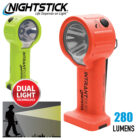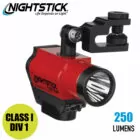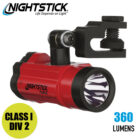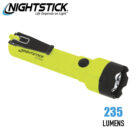


Intrinsically Safe Flashlights, Headlamps and Work Lights
Intrinsically Safe Flashlights, Headlamps & Work Lights
Certified for Hazardous Locations | Class I, II & III | Division 1 & 2 | Brands: Streamlight, Pelican, Nightstick, KBS Innovations, Princeton Tec
Intrinsically safe flashlights, headlamps, and work lights are not ordinary lighting products. They are precisely engineered, independently tested, and third-party certified devices that eliminate the risk of ignition – even under fault conditions – in the most dangerous working environments on earth. If you or your team works in a hazardous location, the light you carry isn’t a preference. It’s a compliance requirement and a safety obligation. BrightGuy is an authorized distributor of intrinsically safe lighting from the industry’s most trusted brands – Streamlight, Pelican, Nightstick, KBS Innovations, and Princeton Tec – stocking the complete range of certified flashlights, headlamps, and work lights for every hazardous location classification.
What Does “Intrinsically Safe” Mean?
Intrinsically safe (IS) is a specific engineering protection method and certification standard that ensures a device cannot release sufficient electrical or thermal energy – under normal or fault conditions – to ignite a surrounding explosive atmosphere. This is achieved through two core design principles:
1. Energy Limitation: Intrinsically safe devices operate on severely restricted electrical parameters — typically below 29V DC and under 300mA. At these levels, even a direct short circuit cannot produce a spark with enough energy to ignite a surrounding flammable atmosphere. The circuitry is designed so that no single fault, and no combination of two faults, can create ignition-capable energy.
2. Temperature Limitation: Beyond spark prevention, intrinsically safe devices are engineered so that no component – under normal operation or abnormal fault conditions – can reach a surface temperature high enough to ignite the surrounding hazardous substance. This is governed by the Temperature Code (T-Code), which specifies the maximum surface temperature a device will reach.
The Rating System Explained: Classes, Divisions, Groups
Every intrinsically safe light carries a certification marking that tells you precisely which hazardous environments it is approved for. Understanding this system is essential for compliance and worker safety. A light certified for one class is not automatically certified for another.
Classes – What Type of Hazardous Material Is Present?
Class I – Flammable gases, vapors, or liquids – Oil & gas, refineries, chemical plants, laboratories
Class II – Combustible dusts – Grain elevators, flour mills, coal mines, pharmaceutical manufacturing
Class III – Ignitable fibers and flyings – Textile mills, sawmills, cotton gins
Divisions – How Likely Is the Hazard?
Division 1 – Hazard likely – ignitable concentrations present under normal operating conditions. The highest-risk classification.
Division 2 – Hazard possible – ignitable concentrations normally contained in closed systems; present only under abnormal conditions (equipment failure, accident). Important: All lights rated for Division 1 are also suitable for Division 2 locations. Division 2-only lights are NOT appropriate for Division 1 environments.
Groups – What Specific Material Is Present?
Groups identify the specific gases, vapors, or dusts present.
Zone System (ATEX/IECEx – International Standard)
European and international certifications use a Zone system instead of the Class/Division system.
Industries That Require Intrinsically Safe Lighting
Oil & gas, refineries, mining, chemical & pharmaceutical manufacturing, grain handling, food processing, wastewater treatment, utilities, textile industries, fuel storage industries.